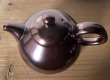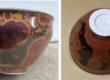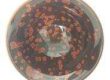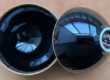

Ceramics is one of the great inventions of the Chinese nation. Thousands of years of ceramic development have given humanity many precious and rare glazed treasures — Jian ware, oil-spot glaze, Yohen Tenmoku, iron-red gold-ring glaze, and more. Their ever-changing, unpredictable glaze colors have captivated people the world over, and countless ceramic artists have devoted their entire talents and lives to presenting exquisite ceramic art to the world.
Today there is just such an explorer, devoted to the secrets of precious glazes in ancient ceramics. He graduated in the early 1980s from Northwest Light Industry Institute, a key university under the former Ministry of Light Industry, and has worked in ceramics education and research ever since. Quietly and without seeking recognition, he pursued research into “iron-series kiln-transmutation glazes” — work that most people would consider dry and unremarkable — and it was only in recent years, at the urging of friends, that he began filing invention patents for his research results: “Qibaocai Ceramics and Its Preparation Process” (iron-red glaze), Patent No. ZL 2016 1 0036917.6; “Tianxing Glaze Ceramics and Its Preparation Process” (oil-spot glaze), Patent No. ZL 2018 1 1415481.9; “Preparation Process for Iron-Red Gold-Ring Glaze Ceramics” (gold-cup glaze), patent pending; and gold-thread glaze (hare’s-fur glaze), currently being revived and prepared.
“Iron-series kiln-transmutation glaze” belongs to the category of “Yohen Tenmoku glaze.” According to historical records, during Japan’s Kamakura period (late 12th to 14th century), Japanese monks who studied at the Buddhist temples on Mount Tianmu in Zhejiang Province brought back tea bowls from Tianmu, which is how the name “Tenmoku” came about. Song-dynasty Yohen Tenmoku tea bowls have two distinctive features: round spots, and an extraordinary blue iridescence shimmering around those spots.
Tenmoku ceramics are notoriously difficult to fire, mainly because kiln temperature is so hard to control — the slightest deviation can cause the firing to fail. Because of these minute temperature variations, the patterns that form are endlessly varied, and every piece can truly be called one of a kind.
Among Tenmoku wares, Yohen, oil-spot, and hare’s-fur glazes are the most prized, with Yohen ranking foremost among all the famous wares. The Yohen Tenmoku glaze layer has a translucent dark blue tone, with numerous yellow or pale-yellow mottled spots scattered across the surface, each ringed by a shimmering halo of purplish-blue light. The spots shift color depending on the angle of incoming light, showing red, blue, green, or flashes of gold; viewed from different angles, the colors change in ways so subtle that words cannot fully describe them.

The author successfully fired iron-red glaze and hare’s-fur glaze as early as 1984, but because the firing conditions of the time could barely meet the requirements, such pieces were rarely seen. Once automatic control instruments became available, a new era for firing kiln-transmutation glazes arrived, allowing the researcher’s firing concepts to be much better realized. Exquisite iron-red glazed cups, mugs, and vases followed one after another, prompting the author to remark, from the heart:
The most beautiful thing in an object is its glaze; the most beautiful thing in a person is the heart!
Oil-spot Tenmoku glaze, owing to its uniquely subtle and once-in-a-lifetime production technique, has become a renowned traditional glaze treasured across cultures and eras, and a goal pursued by ceramics practitioners everywhere. Porcelain made with it is dignified, beautiful, and richly varied, making it a true art treasure of the ceramics world — and surviving masterpieces are rare. Oil-spot Tenmoku is characterized by numerous silver-grey crystalline dots scattered across a black glaze, resembling “stars in the night sky” — these are called silver oil-spots; when the dots appear golden-yellow instead, they are called gold oil-spots.

After successfully applying oil-spot glaze to the firing of small bowls and cups, the author was moved to remark once more:
Gentlemen and ladies alike become connoisseurs; gold cups and silver cups alike earn great acclaim!
This cup is offered, with respect, to all who love ceramics.

Oil-Spot Glaze Work — Bodhidharma
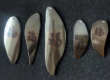
Hare’s-fur streaks form because the iron crystals that would otherwise create oil-spots flow downward together with the glaze; differing flow rates create beautiful brownish-yellow, blue-green, pale brown, or rust-colored streaks resembling hare’s fur within the black glaze, with a strong sense of depth and dimension. When the tone leans golden-yellow, it is called golden hare’s-fur. Not a single one of the author’s finest golden-red streaked pieces survives today — only two early test pieces remain.

According to an article in China Ceramics, issue 5, 1982, the Tangshan Ceramics Research Institute in Hebei Province, with assistance from the Department of Chemical Engineering at Tsinghua University, achieved a notable research success: the development of iron-red gold-ring crystalline glaze. More than fifty ancient-ceramics experts, professors, and engineers from across the country evaluated it and concluded that iron-red gold-ring crystalline glaze is one of the true treasures among crystalline glazes, a rarity both in China and abroad.
Today, the author has once again pushed iron-red gold-ring glaze to new heights, reaching a level never achieved before and holding an absolutely leading position in the field!


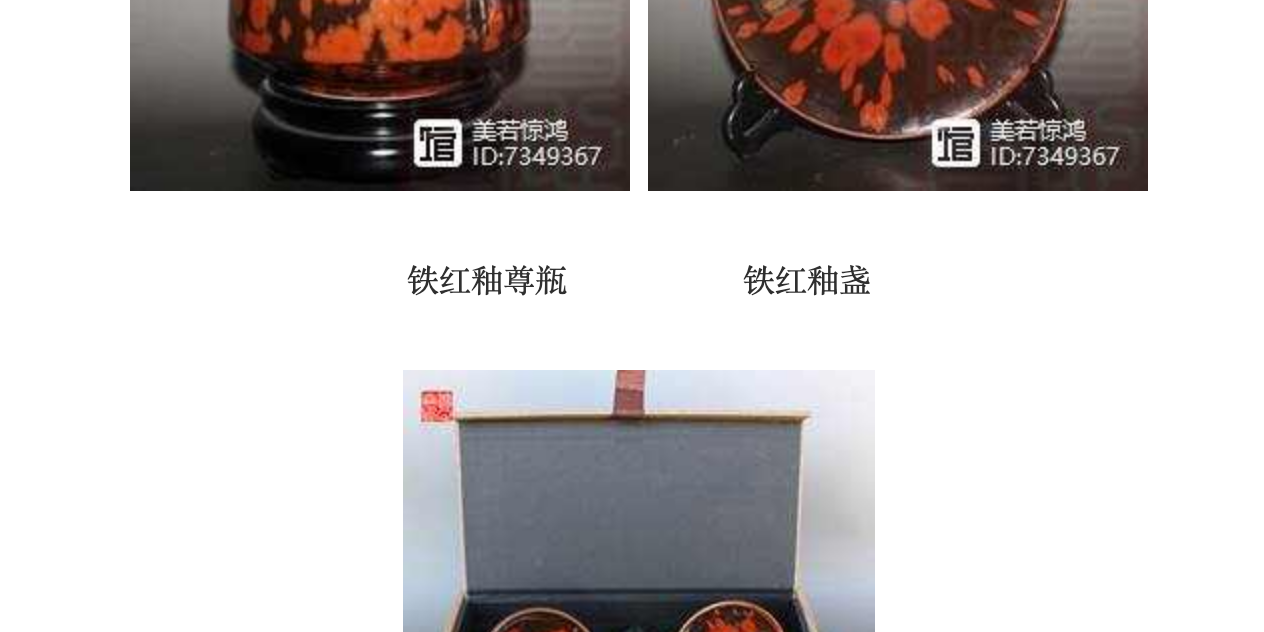
Iron-red gold-ring glaze is a treasure among treasures. The author has carried this ancient, famous glaze to a new height — the saturation of red and black reaches perfection, the golden rings are clear and bright, and the patterns are lively and lovely. The author remarks once more: this is truly a fiery-red era, golden growth rings! Crossing through the ages, moving toward the future!
Even today, very few people fire iron-series kiln-transmutation glazes, mainly because the firing is extremely difficult, so few attempt it.
Firing large iron-series kiln-transmutation pieces is harder still — fine examples are rarely seen!

Over decades of research, the author says: first, settle your mind and pursue one subject deeply; second, research with a calm and focused spirit. Only then can true inspiration be sparked — flashes of insight can even come in dreams.
The author’s long-studied “iron-series kiln-transmutation glaze” antique-style series is fired at a high temperature of 1350°C, giving the glaze surface high color saturation and excellent gloss, producing an elegant and pleasing visual effect. Every piece is made entirely by the author’s own hand. Because the firing conditions for kiln-transmutation glaze are so demanding, the number of works is extremely limited, and each one has its own individual character — every piece is truly one of a kind!
As a collector’s piece, you become one of the few owners!
As a gift, you become a noble giver!
Reading this article, you become an appreciator of art!
Finally, here is a couplet the author, Mr. Liao, composed using the characters of his own given name, Meihong (美鱋):
美景常在不为美 — Beauty is ever-present, yet the word “beauty” (Mei) alone cannot name it
鱋运难求强名鱋 — Great fortune (Hong) is hard to attain, yet the word “vast” alone cannot claim it
美若惊鱋 — “As beautiful as a startled swan in flight” — the two closing characters spell out the author’s own name, Meihong
February 2020