
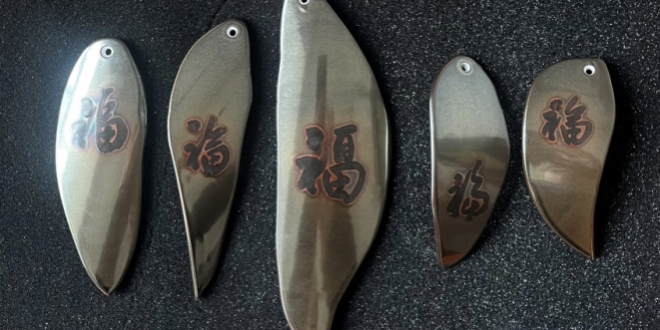
— The Culminating Work of My Kiln-Transmutation Glaze Research
Spending an entire lifetime on a single pursuit may sound almost unbelievable, yet that is exactly what I have done, applying what I learned to forty years of research into iron-series kiln-transmutation glazes. The rewards have been abundant — at times I would enter a kind of dialogue between person and object, occasionally I would even hear guidance from a wise teacher in my dreams, and sometimes a subtle insight would suddenly surface. Through it all, my heart has been filled with joy!
The scope of iron-series kiln-transmutation glaze is broad in the general sense. Among its many branches, I chose to systematically research two particularly challenging glazes that few have attempted: iron-red glaze and oil-spot glaze. Now that this project combining iron-red glaze and oil-spot glaze on decorative ceramic panels is complete, my lifetime of research comes to a natural pause here — leaving some room for whoever is meant to carry it forward.
This project combining iron-red glaze and oil-spot glaze on decorative ceramic panels was considerably difficult, mainly because the two glazes require different firing regimes; combining them while fully preserving each glaze’s distinct character was truly no easy task. After a long series of trials, the author finally arrived at a satisfying result.
During trial production, satisfying the firing requirements of iron-red glaze while also accommodating the characteristics of oil-spot glaze proved genuinely difficult. The author tried different kilns, different clay bodies, and different firing curves; through extensive trials and by continually drawing lessons from each attempt, a compromise was finally found: each glaze gives up a little — the oil-spot glaze’s golden sheen is slightly diminished, and the iron-red glaze cannot show its golden ring — yet the overall visual effect remains very good. This is already the best method found for combining the two on a single piece.
As is well known, kiln-transmutation glazes are extremely demanding when it comes to the clay body: the same glaze applied to different clay bodies can produce results so different you would hardly imagine them related. So the process behind these decorative ceramic panels is a genuinely complex one — perhaps more so than you might expect.
The research began in early 2022, when Fujian Province held the “Fu Wang Fu Lai, Fujian Lai Jian” Fujian “Fu” (Blessing) Culture and Creative Design Competition. The government of Fangtian Township in Ninghua County, my hometown, invited me to take part by firing pieces with my kiln-transmutation glaze to enter the competition. This was the first stage of experimentation.
First, I used a gold glaze as the background color and asked my colleague Mr. Lu Meibin to write characters with colored glaze. However, the gold glaze formula had some issues at the time, and the golden glaze surface did not reach its best state, so the overall effect was unsatisfying.

Golden Leaves Bring Blessing
Second, I again used a gold glaze as the background and applied iron-red glaze to a relief-carved “Fu” (Blessing) character, firing it in a single pass. But once again, because of issues with the gold glaze, the background did not come through, and the result was again unsatisfying.

“Yi-style” Fu Character — “The World’s Number One Fu” — “Yi-style” Fu calligraphy by Deng Shaohua
The second stage was again directly tied to my hometown. In early 2023, my extended family built a new ancestral hall together, and once it was completed I gave it the name “Liuhe Tang” (Hall of Six Harmonies). I wanted to fire three large characters to be set into the hall’s front wall. This stage proved even more difficult — firing a large 45cm flat panel in a kiln with only a 50cm interior chamber. After many trial firings, I finally began formally firing the two large panels shown below; to maximize the cooling rate, I fired only one panel at a time. In the end, neither the iron-red background nor the gold of the characters reached a normal result, so the third panel was never fired — I will fire it once I find an ideal firing method. Using a larger kiln to fire large-format works has always been my final wish, and I am certain it will be realized before long.

“Liuhe Tang” Hall Plaque Characters
Third stage: I decided to be more modest and return to firing in a small kiln. By this time it was early 2024, and this attempt finally achieved a perfect result. Along the way there were issues such as cracking and flaking, but these were an inevitable part of accumulating experience. One piece bearing the character for “longevity” (Shou) was submitted to the Min Yi Cup competition, where it won a bronze award.

Cracking Defect — Flaking Defect


A Flawless Piece
Summary: the process for firing decorative ceramic panels in Kiln No. 2 is now well established. A few points deserve attention in future production and firing: first, the base panel can be made somewhat thicker for a greater sense of weight; second, the regularity of both the base panel and the characters should be improved to raise overall quality; third, glazing the underside as well and firing top-down reduces warping.
The results of this project have very broad applications — house plaques, festive blessings, auspicious phrases, family-name plaques, and more. Red and gold are colors the Chinese people have always loved, and combining both within a single kiln-transmutation glaze makes the result all the more distinguished.
December 20, 2024