
My research into iron-series kiln-transmutation glazes has now spanned several decades — it’s time to bring it to a close. This year’s review will be the last of its kind; going forward I will focus more on nurturing body, mind, and spirit.
In 2024, I mainly carried out the following work:
First, in January 2024, my company signed an industry-university-research cooperation agreement with the School of Materials Science and Engineering at Shaanxi University of Science and Technology, to jointly carry out research, development, and transmission of iron-red gold-ring glaze. This is a brand-new platform that will strongly promote the advancement and development of this project.
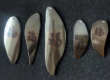
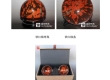
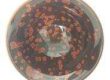
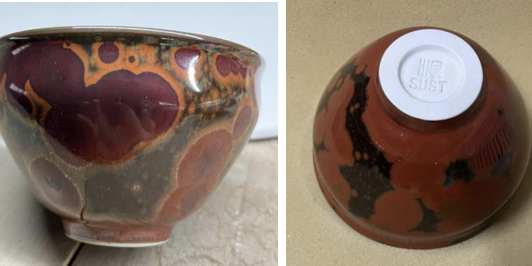
At the turn of the year, I devoted myself entirely to firing the “95 Zun” cup, marked on the base with SUST, the English abbreviation for Shaanxi University of Science and Technology. For this I specially ordered two small electric kilns (labeled 0-1# and 0-2#), and once tuned to their optimal firing state, fired eight cups a day: No. 2 clay body with No. 816B glaze. This produced a very distinctive glaze surface — the red blooms grew somewhat larger, the deep red blooms even showed a gradient effect, and the overall visual effect of the glaze became deeper, more compelling to look at, and richer in character.
Firing No. 1 clay body with a mixed glaze in Kiln No. 4 produced an iron-red glaze with a black base, red blooms, and golden rings; firing the same No. 1 clay body with the mixed glaze in Kiln No. 1 produced a stunning glaze of super-pure red and pure black.

Firing Results from Kilns 0-1# and 0-2# — Firing Results from Kiln No. 1
Second, I successfully fired red-background, gold-character ceramic panels in Kiln No. 2. Iron-red glaze and metallic (oil-spot) glaze follow different firing curves, so perfectly expressing both glazes on a single piece is genuinely difficult; many earlier trials failed. This time, firing in Kiln No. 2 finally achieved the goal — a wish held for many years was at last fulfilled.

Going forward, this method can be used to develop a whole series of works:
1. House and building name plaques; 2. Study and studio plaques; 3. Festive plaques; 4. Special-character plaques; 5. Family-name plaques; 6. Plaques bearing traditional auspicious words or characters, and more.

Third, trials replacing raw materials in the iron-red glaze. I substituted Rushan quartz and a feldspar specifically formulated for metallic glazes for the quartz and feldspar in the original iron-red glaze formula. The trials showed that raw materials have a huge effect on the color development of iron-red glaze: Rushan quartz proved of little value — substituting it made the result worse — while the specialized feldspar worked well and gave the glaze surface a new character.

No. 1 Clay Body, Kiln No. 4, Quartz Substituted — No. 2 Clay Body, Kiln No. 4, Feldspar Substituted — No. 1 Clay Body, Kiln No. 4, Feldspar Substituted

No. 2 Clay Body, Kiln 0-2#, Feldspar Substituted — No. 3 Clay Body, Kiln 0-2#, Feldspar Substituted — No. 1 Clay Body, Kiln 0-2#, Feldspar Substituted
The very same glaze produces completely different colors on different clay bodies, and fired in different kilns the difference is greater still — this is the very charm of kiln-transmutation glaze.
Closing remarks:
The years turn over, and time slips away easily. This autumn I spent a month alone in Weihai, Shandong, seriously reflecting on the life ahead of me. Some work should simply be set down. I hope the next generation will take up the torch and carry iron-series kiln-transmutation glaze to new heights; for what still needs dedicated effort, let us work at it together. One’s life goals must be clear!
Liao Meihong Studio
December 3, 2024
Addendum:
- 4. Development of Persimmon-Red Glaze
After finishing this year-end review, I suddenly felt the urge to continue the trial of substituting feldspar in the iron-red glaze, and firing it with the metallic-glaze method in Kiln No. 1 produced a good persimmon-red glaze effect.

Kiln No. 1, No. 1 Clay Body, No. 202454A Glaze — Kiln No. 1, No. 1 & No. 3 Clay Bodies, No. 202454B Glaze
Firing in Kiln No. 1 yields far too few pieces at a time, so I thought it would be better to fire in Kiln No. 2 or an even larger kiln. I first ran trial firings in Kiln No. 2, and after only five attempts I had worked out the firing for both matte and glossy versions of persimmon-red glaze — a result made possible by years of accumulated firing experience.

Matte Fired in Kiln No. 1 — Glossy Fired in Kiln No. 2

Persimmon-Red Glaze Twin Stars

Comparison of Matte Persimmon-Red Glaze Fired in Kilns No. 1 and No. 2
5. Reappearance of Rose Purple-Gold Glaze
Some years ago, gold oil-spot glaze had occasionally produced purple-gold and ink-black tones, but these were only chance occurrences, and I had never worked out a reliable firing method for them. I had planned to slowly research this again in 2025, but to my surprise I suddenly cracked the rose purple-gold color this time. This month’s research results came like a gusher — thoroughly fascinating!

No. 1 Clay Body, No. 07 Glaze — No. 4 Clay Body, No. 07 Glaze — No. 3 Clay Body, No. 07 Glaze
December 28, 2024