
Introduction
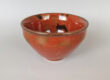
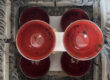
Iridescent iron-red crystalline glaze is also known as iron-red glaze or cinnabar-spot glaze. In the Chaoshan region it is sometimes called “iridescent tenmoku.” It is a prized crystalline art glaze, characterized by shimmering, circular crystal blooms ranging from orange-red to golden yellow scattered across a brown or tawny-brown glaze surface. Under light, these crystals refract a brilliant glow, giving the glaze a strong sense of depth and artistic effect that is widely loved.

Experimental Content
Body and Glaze Raw Materials
The body used in this experiment is the same body used in the company’s everyday production of household and display porcelain. After firing at 1250-1300 degrees C it achieves good vitrification, making it suitable for iridescent iron-red crystalline glaze. Its chemical composition, as tested, is shown in Table 1. The glaze uses albite, quartz, calcined talc, bone ash, calcite, kaolin, and glass powder, along with chemical raw materials including red ferric oxide (Fe2O3) and barium carbonate; the chemical composition of the glaze raw materials is shown in Table 2.

Glaze Formula Composition
Through repeated experimentation and adjustment, the formula composition of the iridescent iron-red crystalline glaze was determined, as shown in Table 3; the optimal formula’s glaze equation is:
Glaze Preparation Process
The glaze preparation process parameters used in this experiment were as follows: a wet ball-milling process was adopted, with a material : ball : water ratio of 1 : 2 : 0.8; approximately 500 g of dry material was rapidly ball-milled for 30 minutes; the milled fineness was such that the residue on a 250-mesh sieve was below 0.08%. The glaze should not be milled too fine — somewhat coarser than an ordinary household porcelain glaze; the glaze slurry’s moisture content was 45%-48%.
Glazing Process
This experiment applied the glaze to bisque-fired bodies by dipping, with a glaze thickness of about 0.5 mm. For bodies with more complex shapes, a pouring method may be used instead, though this makes glaze thickness harder to control and demands greater skill from the operator. After glazing, pieces were air-dried naturally or dried using residual kiln heat, and only loaded into the kiln once fully dry.
Firing Schedule
This experiment used rapid firing in a high-temperature, digitally controlled electric kiln. The maximum firing temperature was 1265 degrees C, with a total firing time of 6 hours. To prevent cracking of the semi-finished pieces in the early stages, the temperature was raised from room temperature to 950 degrees C over 4.5 hours; after 1200 degrees C it was rapidly raised to the maximum temperature and held there for 40 minutes; it was then slowly lowered to 1155 degrees C and held for 30 minutes, after which the power was switched off and the kiln allowed to cool naturally. The firing schedule is shown in Table 4.
Results and Discussion
Formation Mechanism of Iridescent Iron-Red Crystalline Glaze
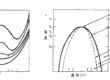
Iridescent iron-red crystalline glaze is a typical liquid-liquid phase-separated glaze. Its brown or tawny-brown color arises from an iron-poor continuous liquid phase together with isolated droplets of an iron-rich liquid phase. Because of the light absorption caused by the iron-rich phase, these droplets appear brown under the microscope, and macroscopically the absorbing effect of countless droplets gives the glaze its overall brown or tawny-brown color. As the temperature rises, the isolated liquid droplets coarsen and aggregate on the glaze surface, undergoing a second separation that forms an iron-rich continuous phase and an iron-poor isolated phase. The iron-poor phase from the first separation and the iron-rich phase from the second differ in viscosity, surface tension, and relative density; the aggregated liquid droplets form spherical globules that float on the surface of the molten glaze. As the glaze melt cools, these spherical globules become fixed in the glaze surface, forming the circular crystal blooms ranging from orange-red to golden yellow.
Effect of Chemical Composition on Iridescent Iron-Red Crystalline Glaze
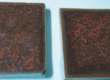
Bone ash and red ferric oxide play a critical role in the formula. Ferric oxide is the main crystallizing and coloring agent, and has a major effect on the artistic quality of the glaze. The optimal amount of iron oxide falls between roughly 12% and 15%. Too little (under 8%) leaves the glaze surface without circular crystal blooms, instead showing a scattered, disorderly pattern of yellow-green spots; too much (over 17%) causes the crystals to merge into patches, unevenly distributed, with a dull glaze color and lusterless crystals that harm the overall appearance. The P2O5 in bone ash is the main phase-separating agent; bone ash is generally added in roughly equal amount to the ferric oxide, which strongly favors the formation of orange-red to golden-yellow circular crystal blooms.
Effect of Preparation Process on Iridescent Iron-Red Crystalline Glaze
Glaze fineness and glaze thickness both have a measurable effect on iridescent iron-red crystallization. If the glaze is milled too fine, crystal nuclei do not form readily, and after firing only a few crystal blooms will be scattered sparsely across the glaze surface; if the glaze is applied too thin, the resulting crystal blooms are small and struggle to grow to the desired size, which harms their artistic effect.
Effect of Firing Schedule on Crystal Formation
The firing schedule has the greatest influence on the formation of iridescent iron-red crystals. A firing temperature that is too high or too low is unfavorable to forming good circular crystal blooms: too high, and the glaze tends to run, producing a mottled glaze with yellow-green spots; too low, and the crystal blooms come out underdeveloped, lacking a strong sense of depth, and are prone to forming dark, gritty crystalline specks — both of which harm the artistic effect. The temperature should be raised quickly as it approaches its maximum. After holding at the peak temperature for 40 minutes, it should be lowered slowly to the crystallization temperature of 1155 degrees C and held there for 30 minutes — a step of great importance to the growth of the iridescent iron-red crystals.

Conclusion
Iridescent iron-red crystalline glaze is a prized crystalline art glaze. Successfully firing a glaze with round, three-dimensional, lustrous, and purely colored crystal blooms requires not only a sound formula and a rigorous process, but also exacting demands on the firing schedule. Firing iron-red crystalline glaze in an electric kiln offers the advantages of simple operation, accurate temperature control, a high yield rate, and a controllable firing schedule. Because iridescent iron-red crystallization is insensitive to kiln atmosphere, the electric kiln is the best choice for rapidly firing iridescent iron-red crystalline glaze.
References
[1] Zhang Yunan. Ceramic Art Glaze Technology [M]. Jiangxi: Jingdezhen Ceramic Institute, 1994.
[2] Li Jiaju. Ceramic Technology [M]. Beijing: China Light Industry Press, 2007, 7.
[3] Huang Dingce. Quality Control of Iron-Red Crystallized Glaze [J]. Shandong Ceramics, 2011, 1.
[4] Shi Xiaotao, Zhang Ting, Fan Xueyun. Study on the Preparation Process of CaO-SiO2-P2O5 Iron-Red Flower Art Glaze [J]. Journal of Ceramics, 2010, 9.
[5] Wang Fen, Zhang Chaowu, Huang Jianfeng. Decoration and Decorative Materials for Silicate Products [M]. Beijing: Chemical Industry Press, 2004, 8.