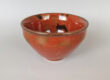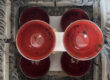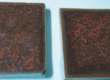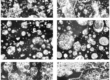

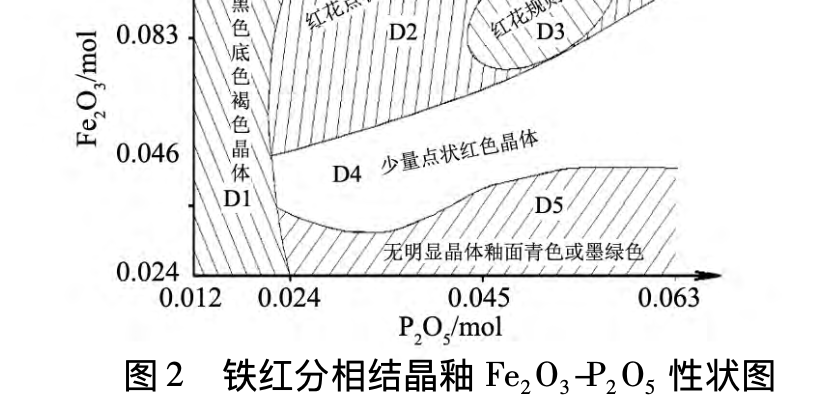
Abstract: A phase-separated iron-red glaze was prepared using potassium feldspar, bone ash, ferric oxide, calcined talc, quartz, and kaolin as raw materials. The changes in glaze surface characteristics caused by the SiO2/Al2O3 molar ratio and the Fe2O3-P2O5 composition were investigated. Combined with XRD, scanning electron microscopy (SEM), and energy-dispersive spectroscopy, qualitative and quantitative analysis of the phase separation and crystallization of the iron-red glaze was carried out. The results show that when the SiO2/Al2O3 molar ratio is 10 and the Fe2O3/P2O5 molar ratio is 2, the glaze surface displays large, evenly dispersed red-flower patterns. SEM and EDS reveal compositional inhomogeneity caused by liquid-phase separation within the glaze, mainly manifested as differences in Fe content; XRD results confirm that the red crystals precipitated in the iron-rich phase are Fe2O3.